
Derila Ergo Pillow Review (2026)
An Honest Look at the Butterfly Contour Memory Foam Design
If you’ve woken up with a sore neck more than once and started questioning your pillow, you’re not alone. The Derila Ergo Pillow uses a butterfly-shaped high-density memory foam core intended to encourage a more neutral head and neck position during sleep. As “ergonomic” becomes an overused marketing term, it helps to look past the claims and examine the actual design, real-world performance, and limitations.
This review covers the key specifications, practical benefits, potential drawbacks, and who is most likely to benefit — based on structural design analysis and long-term user feedback patterns.
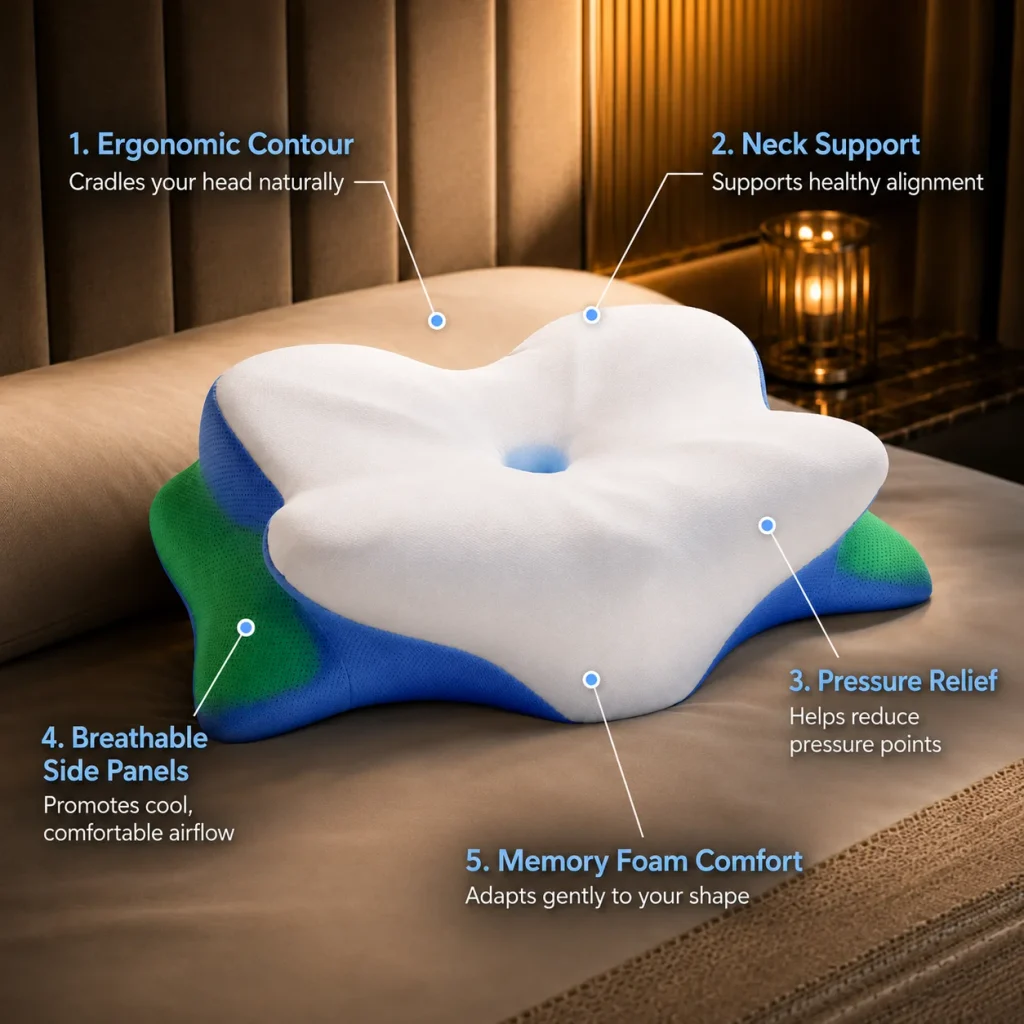
Quick Specs & Dimensions
| Feature | Details |
|---|---|
| Material | High-density memory foam with open-cell structure for better airflow |
| Dimensions | Approximately 54 × 36 × 13 cm (about 5.1 inches loft) |
| Design | Butterfly contour with central head cradle and side wings for shoulder clearance |
| Best Suited For | Side sleepers and back sleepers |
| Cover | Removable, machine-washable (hypoallergenic) |
| Durability Notes | High-density foam is designed to resist rapid sagging better than low-grade or poly-fill alternatives |
What Is the Derila Ergo Pillow?
The Derila Ergo pillow is a contoured memory foam pillow designed to provide more structured support than a traditional flat pillow. The central cradle is meant to hold the head, while the front edge and side wings aim to support the natural curve of the neck and accommodate the space between the shoulder and head for side sleepers.
It is positioned as a posture-support pillow rather than a medical device. It does not treat neck pain, spinal conditions, or sleep disorders. Results depend on individual anatomy, sleeping position, mattress firmness, and personal preference for firmness.

Unboxing and Initial Setup
Like most quality memory foam products, the Derila Ergo ships vacuum-compressed.
- Off-gassing: A mild chemical or “factory” smell is common when first opened. This is typical of polyurethane foams (VOC off-gassing). Leaving the pillow in a well-ventilated space for several hours (often 8–12) usually eliminates the odor.
- Expansion time: Allow 2–4 hours for the foam to fully expand to its intended height and density. Sleeping on it immediately after opening may not provide the designed support level.
The Pros: What Works Well
Intentional neck positioning
The central hollow cradles the head while the raised front edge supports the cervical curve. This “bridge” design aims to reduce the tendency of the head to tilt upward or downward, which can contribute to muscle strain for some users.
Butterfly wing design for side sleepers
The raised side sections help fill the gap between the shoulder and ear. This can prevent the shoulder from hunching upward toward the neck — a common source of discomfort for side sleepers on flat pillows.
Stability over the night
High-density memory foam resists the progressive flattening that many traditional pillows experience. Users who prefer consistent loft often appreciate this.
Airflow and cover
The open-cell foam structure and breathable, washable cover generally handle heat better than older closed-cell memory foams. The official covers are cut to match the butterfly shape, reducing excess fabric that can bunch under the neck.
Travel practicality
The relatively compact size and ability to compress make it more manageable for travel than many bulky traditional pillows.
The Cons: Important Limitations
Adjustment period
Most users need 3–7 nights to adapt. The medium-firm contoured feel can initially feel unfamiliar or slightly firm for those coming from soft, flat pillows.
Not ideal for stomach sleepers
At approximately 13 cm (5.1 inches) of loft, the height can force the neck into an upward angle for many dedicated stomach sleepers. This may increase strain rather than reduce it.
Height is fixed and subjective
One size does not suit every body. Taller or broader-shouldered users often find the loft appropriate. Smaller-framed or shorter-necked individuals may find it pushes the chin forward too much.
Active sleepers
People who toss and turn frequently may slide out of the central cradle onto the firmer side wings, which can feel abrupt.
Cover compatibility
Standard rectangular pillowcases often leave excess fabric that bunches and can interfere with the contour. Official or properly fitted covers work best.
Returns logistics
As with many direct-to-consumer products that ship internationally, the return process can involve more steps than buying from a local retailer. Always check the current return policy and any associated costs before purchasing.
Who Is This Pillow Best For?
| Recommended For | Consider Avoiding If |
|---|---|
| Side and back sleepers | Dedicated stomach sleepers |
| People seeking more structured support | Those who prefer ultra-soft, “cloud-like” pillows |
| Users frustrated by pillows that flatten overnight | Active “rotary” sleepers who change positions frequently |
| Average to taller frames (roughly 5’6″+) | Very petite or short-necked individuals who need lower loft |
| Those willing to allow a short adjustment period | Anyone unwilling to try a different shape and firmness |
How to Evaluate Any Ergonomic Pillow
When assessing contoured or memory foam pillows, focus on practical performance rather than marketing language:
- Nose-to-chest alignment
In your primary sleep position, your nose should roughly align with the center of your chest. If it tilts significantly up or down, the loft is likely wrong for you. - Match loft to shoulder width
Broader-shouldered side sleepers typically need higher loft (around 4–6 inches) to keep the head level. Narrower frames often prefer less height. - Consider your mattress
A soft mattress lets your body sink, reducing the effective gap that the pillow needs to fill. A firm mattress keeps you higher, so a more structured, taller pillow is often more effective.
These simple checks help determine whether a fixed-contour pillow like the Derila Ergo is likely to suit your body and sleep setup.
Longevity Expectations
High-density memory foam is generally more resistant to permanent compression than low-density foam or fiberfill. With proper care (keeping the core dry and using a clean cover), consistent support for 2–3 years is a realistic expectation for many users. The foam should never be submerged in water or exposed to high heat, as this can degrade the cellular structure.
Bottom Line: Is the Derila Ergo Worth It?
The Derila Ergo Pillow is a structured support tool rather than a soft, plush cushion. It prioritizes consistent positioning and loft stability over immediate sink-in softness.
If you primarily sleep on your side or back, experience morning neck or shoulder stiffness with traditional pillows, and are willing to adapt over several nights, many users find the design improvement worthwhile. The butterfly contour and shoulder-clearance wings address specific anatomical gaps that flat pillows often leave unsupported.
However, if you prefer a soft, foldable pillow, sleep primarily on your stomach, or have a smaller frame that needs lower loft, this model is unlikely to be the right match. It is not a medical device and will not resolve clinical issues such as sleep apnea.
For the right sleeper — side or back, medium-firm preference, seeking more stable overnight positioning — the Derila Ergo offers a thoughtful contoured design at a competitive price point, especially when current promotions and the typical 30-day return window are factored in.
Always verify the latest dimensions, return policy, and promotions directly on the official website before ordering.
Leave a Reply